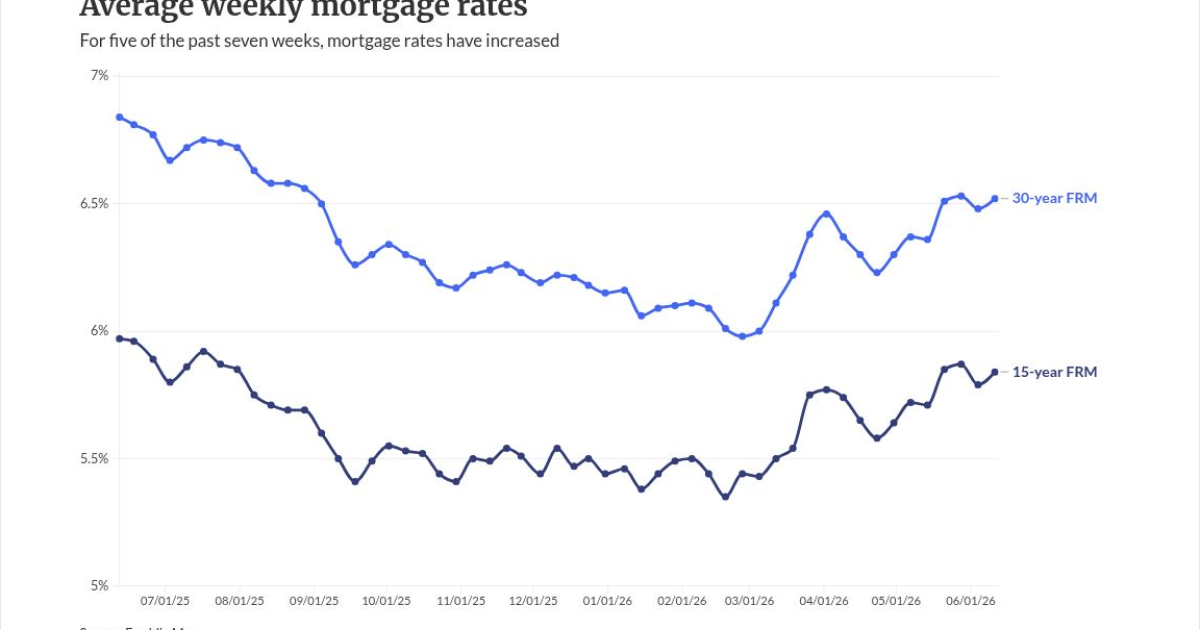
With indicators showing the U.S. economy is heating up based on employment and inflation reports, mortgage rates moved 4 basis points higher this week.
Zillow's data showed mortgage rates resuming their climb as well.
"Together, the data reinforce a 'higher-for-longer' view: markets have largely abandoned hopes for rate cuts this year, Treasury yields rose, and mortgage rates restarted their ascent," said Kara Ng, senior economist at Zillow Home Loans, in a Wednesday evening statement. The statement came out prior to the Producer Price Index release, which found May's 1.1% month-to-month gain exceeded expectations. This reinforced the Consumer Price Index data released Wednesday.
This week's mortgage rate data
The 30-year fixed-rate mortgage averaged 6.52% as of June 11, according to the Freddie Mac Primary Mortgage Market Survey. This is
Meanwhile, the 15-year FRM averaged 5.84%, a gain of 5 basis points from the prior week's 5.79%. But the
"Stronger
"Importantly, we're seeing homebuyers look past the short-term rate fluctuations and actively enter the market, signaling renewed confidence in homeownership opportunities."
The 10-year Treasury yield, which is a benchmark used to price mortgages, looked to already have the inflation data expectations taken into account by investors.
Yields have been in the area of 4.53% since last Friday, after the June 4 close at 4.48%.
Between Wednesday's close and Thursday at 11 a.m., it dropped 2 basis points to 4.52%.
Lender Price data on the National Mortgage News website showed the 30-year FRM at 6.74% at 11 a.m. on June 11, a 1 basis point increase from the previous week.
Conforming mortgage rates as measured in the Mortgage Bankers Association's Weekly Application Survey for the period ended June 5, rose 3 basis points to 6.6%. Jumbo rates were flat with the previous week at 6.65%, while Federal Housing Administration-insured mortgages had an average price of 6.27%, up 1 basis point.
What drove lending activity for the period
"Mortgage rates were volatile last week as news from the Middle East continues to drive markets," said Mike Fratantoni, the MBA's chief economist, in the Wednesday data release. "While the average rate was up slightly, there were opportunities where borrowers were seeing somewhat lower rates."
Refinance applications made up 40.2% of volume, up from 38% one week prior. A 15% gain in the refi component helped the Market Composite Index rise 10.8% on a seasonally adjusted basis for the week.
How the inflation data affects housing
"Mortgage rates and the typical monthly payment are still lower than a year ago, and the share of listings affordable to a median-income household remains above last year's — but the higher rates climb, the faster those affordability gains evaporate," Ng said. "With inflation rising faster than incomes, any savings on housing are getting eaten by the cost of everything else, leaving the typical buyer net poorer."
Upward pressure on mortgage rates is building, added Kate Wood, NerdWallet's lending expert in a Thursday morning statement.
How Europe could impact Fed decision making
The Federal Open Market Committee is likely to hold rates steady at its June meeting,
"But the European Central Bank announced a quarter-point raise today and markets anticipate the Bank of Japan hiking rates next week," Wood said. "War-driven inflation is a global issue, and it's hard to imagine mortgage rates falling against this backdrop."
With the Iran conflict apparently flaring up again, it is likely to push bond yields, and ergo mortgage rates, higher, Wood said.
The ECB blinked first, said Nigel Green, CEO of financial advisory the deVere Group.
"This move increases the pressure on the Fed to take a harder look at whether current policy settings remain appropriate in a world where inflation is moving in the wrong direction again." U.S. policymakers should not assume these inflationary pressures will fade on their own.
"Europe has moved first," said Green. The question investors must now ask is whether the Fed will be forced to follow."