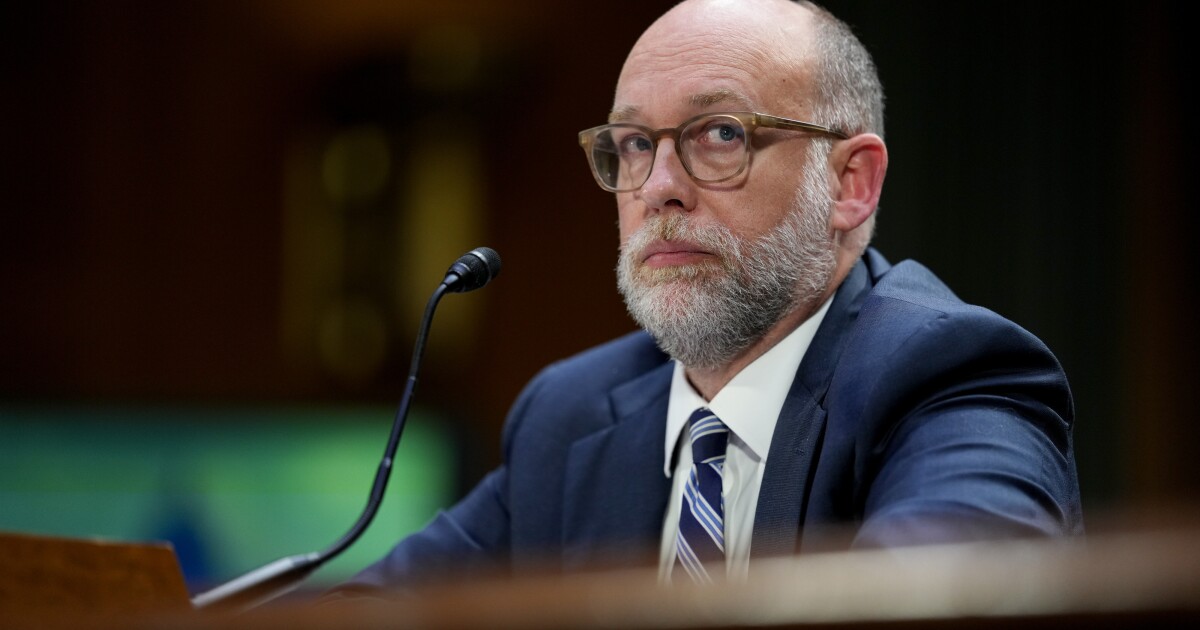
- Key insight: A group of 22 state attorneys general — all Democrats — filed a lawsuit against the Consumer Financial Protection Bureau, Federal Reserve and acting CFPB director Russell Vought, challenging the administration's position that the Fed can only fund the CFPB when the Fed itself is profitable.
- Expert quote: "The failure to request funding will cripple or entirely shut down the CFPB's Consumer Response System to Plaintiffs' detriment. Much of the damage will be irreversible." — lawsuit
- Forward look: The suit mirrors arguments made by the National Treasury Employees Union, which represents CFPB employees, in their separate suit challenging Vought's efforts to radically reduce the agency's workforce.
A group of 22 Democratic Attorneys General filed a lawsuit Monday challenging the administration's legal view that the law does not allow the Federal Reserve to fund the Consumer Financial Protection Bureau when the central bank is not profitable.
The suit, filed in the U.S. District Court for the Eastern District of Oregon, argues that the CFPB provides statutorily mandated functions like maintenance of the consumer complaint database and the compilation of Home Mortgage Disclosure Act data. Attorneys general from New York, New Jersey, Oregon, California, Colorado, Arizona, Connecticut, Delaware, Washington, D.C., Hawaii, Maryland, Maine, Illinois, Massachusetts, Michigan, Minnesota, Nevada, New Mexico, North Carolina, Rhode Island, Vermont and Wisconsin joined the suit.
Those statutory functions are critical for the AGs to build and prosecute consumer protection enforcement actions, the AGs argue. The administration's
"The Plaintiffs will be injured if Defendant Vought engineers a CFPB shutdown by unlawfully refusing to request operating funds from the Federal Reserve," the lawsuit said. "The failure to request funding will cripple or entirely shut down the CFPB's Consumer Response System to Plaintiffs' detriment. Much of the damage will be irreversible."
Vought — who has been heading the CFPB since he was confirmed to lead the White House Office of Management and Budget in February — has
As part of that lawsuit, the Justice Department's Office of Legal Counsel submitted a memorandum to the court saying that the government's legal position was that the Federal Reserve cannot fund the CFPB presently because the central bank has not turned a profit on its open market operations and thus has no "combined earnings" with which to fund the agency.
The CFPB has a unique funding structure whereby the agency requests its annual operating budget from the Fed, with the request being
The lawsuit counters that the administration's position is at odds with the Federal Reserve's own accounting principles, which differ in important ways from the accounting terms and principles that apply to private companies. The Fed routinely realizes paper losses, typically during periods of elevated interest rates, and when that happens the central bank ceases disbursements to the Treasury and instead records a "deferred asset" on its balance sheet that will be made up to the Treasury with future profits when open market operations once again are profitable.
"The Federal Reserve does not use the kinds of accounting procedures and terminology that private sector banks use. Because the Federal Reserve's actions are driven by public policy goals — like economic stability — rather than an attempt to produce a profit for shareholders, the Federal Reserve has created its own 'specialized accounting principles' specific to 'the nature and function of a central bank,'" the lawsuit said. "OLC's strained interpretation of 'combined earnings' is legally erroneous. It is contrary to the plain meaning of the term, inconsistent with structure of the Dodd-Frank Act and Congressional intent, at odds with the statutory purpose of the Federal Reserve, and based on illogical inferences."
The suit cites an
The suit also argues that the CFPB's Consumer Response System — which allows individual consumers to register complaints about financial companies and provides a process for having those complaints addressed — is a required function of the bureau, and one that the administration cannot unilaterally decide not to fund.
A critical part of that system is data sharing with state AGs, the complaint said, and the bureau is also responsible for compiling and sharing Home Mortgage Disclosure Act data with state agencies. The court should find that the OLC memo is unlawful and compel the administration to fund the agency's core functions, the suit said, before the Consumer Response System is shuttered for good.
"No constitutional or statutory authority authorizes the CFPB to refrain from fulfilling its statutory duties, or to violate federal law by refusing to request funding sufficient to maintain its statutory obligations, including maintenance of the Consumer Response System it is required to make available to Plaintiffs," the lawsuit said. "By failing to request funding from the Board of Governors, Defendant Vought puts the operations of the CFPB as a whole at risk of imminent cessation in their entirety."