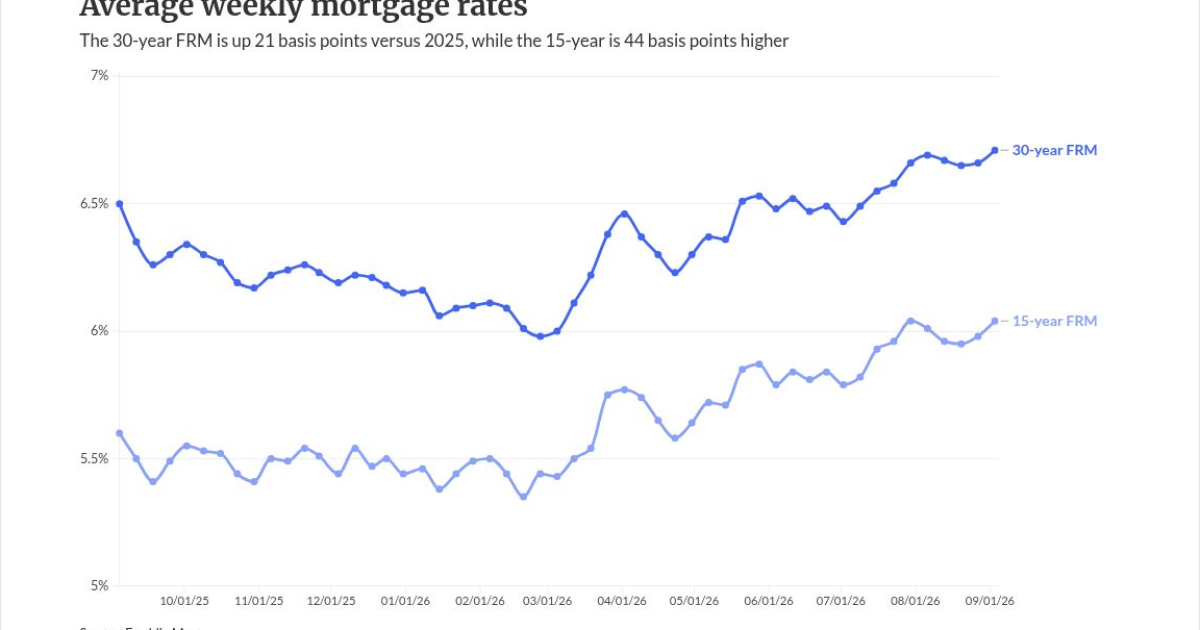
Surging 10-year Treasury yields pushed mortgage rates deeper into high-six-percent territory this week — its highest point since the start of 2025 — effectively stalling refinance momentum while leaving purchase-market buyers to navigate a new high-rate environment.
The 30-year fixed-rate mortgage averaged 6.71% on Sept. 3, the Freddie Mac Primary Mortgage Market Survey reported. The last time it was at this level was
The other rate the PMMS tracks, the 15-year FRM, averaged 6.04%, up from last week when it averaged 5.98% and last year at this time at 5.6%.
Other rate trackers also reported gains in the 30-year FRM this week, which is no surprise following
"Warsh said just enough in his Jackson Hole speech for markets to decide a September rate hike isn't just possible, but probable," Wood said. "A few FOMC members hinting at holding rates steady dropped the odds this morning, but markets still consider a September increase significantly more likely than they did just seven days ago."
Renewed action by the U.S. military against Iran brought back inflation fears, pushing bond yields, and as a result mortgage rates, higher, said Wood.
The 10-year yield twice this past week reached 4.8%, a point it briefly touched Jan. 13 and 14 of 2025. But it has not had a long term residence above the mark since Nov. 1, 2023, according to Yahoo Finance.
But its intraday high on Tuesday was 4.8% and the following day 4.806%; both days it closed at 4.796%. On Thursday morning, it opened at 4.766%.
The conforming 30-year FRM as tracked by Optimal Blue was at 6.655% on Aug. 26. By Sept. 2, it was up to 6.78%, an increase of 12.5 basis points.
The Mortgage Bankers Association's Weekly Application Survey released yesterday for the period ended Aug. 28, reported the conforming 30-year FRM at an average of 6.79%, a gain of 1 basis point from the prior week. Meanwhile, both jumbo and Federal Housing Administration-insured mortgages were 3 basis points higher.
"Mortgage rates reached their highest levels in four weeks as investors' concerns about inflation and growing deficits push yields higher across the globe," said Mike Fratantoni, the MBA's chief economist in the WAS press release.
Even with the higher rates, application activity was 0.8% higher on a seasonally adjusted basis, noted Bob Broeksmit, the MBA's president and CEO, in a follow up statement issued on Thursday morning.
"While affordability remains a challenge, the increased supply in many local markets is helping support homebuying activity," Broeksmit said. "We expect mortgage rates to remain around 6.7% for the foreseeable future, with incoming economic data critical to their path."
In the his PMMS comments, Freddie Mac Chief Economist Sam Khater zeroed on homebuyer activity even as rates rose.
"Purchase demand has remained relatively stable indicating steady interest from buyers adapting to evolving market conditions," Khater said.
Meanwhile, the rate change predictions for September's Federal Open Market Committee have shifted again, likely after
Still, slightly more contributors to the CME Group's FedWatch, 50.3%, are expecting a 25 basis points boost to the fed funds rate. On Wednesday, this was 63.2%.
It reverses a shift in the tracker, which started leaning towards a hike following Warsh's speech.
While the FOMC actions do not directly move mortgage rates, their implications influence the traders in pricing products like the 10-year Treasury.
Friday's jobs report, if it is "a continuation of July's dismal performance," could give the FOMC a stronger case for not raising rates, Wood said. A stronger showing, unless it involves a revision of July data, doesn't make for a dramatic shift towards a hike either, she continued.
"Neither would be likely to shift mortgage rates much, and that may be the bad news," Wood said. "While average 30-year fixed rates remain in the high sixes, plenty of mortgage lenders are already advertising sample rates that start with seven."
Given those sample rates are marketed towards the borrowers with the highest credit scores, "a borrower with a more modest financial profile is almost certainly getting quotes that are in the 7% range," Wood noted.