The Federal Housing Finance Agency is seeking authority to pursue fraud more aggressively in its latest annual report to Congress.
The agency, which Director Bill Pulte calls U.S. Federal Housing, requests statutory amendments that would call for the agency to "make appropriate referrals on discovering suspected fraud" and give it more authority to pursue civil enforcement actions.
"FHFA believes that all federal regulators of mortgage market participants should be empowered to take action against fraud," he wrote.
While President Trump has welcomed Pulte's anti-fraud efforts, Democrats have alleged politicization that has led to a
FHFA's current responsibilities include getting fraud reports from entities it oversees like government-sponsored enterprises Fannie Mae and Freddie Mac, and taking certain actions like issuing
Typically, the GSEs remedy fraud by asking lenders and other counterparties to make good on representations and warranties related to the integrity of the loan data. However, the FHFA does have some limited power to pursue enforcement actions.
FHFA would like that authority broadened so it can directly pursue civil enforcement claims against fraud suspects. It also seeks to make "appropriate" referrals based on suspected fraud a statutory directive.
The agency also reprised some past interest in
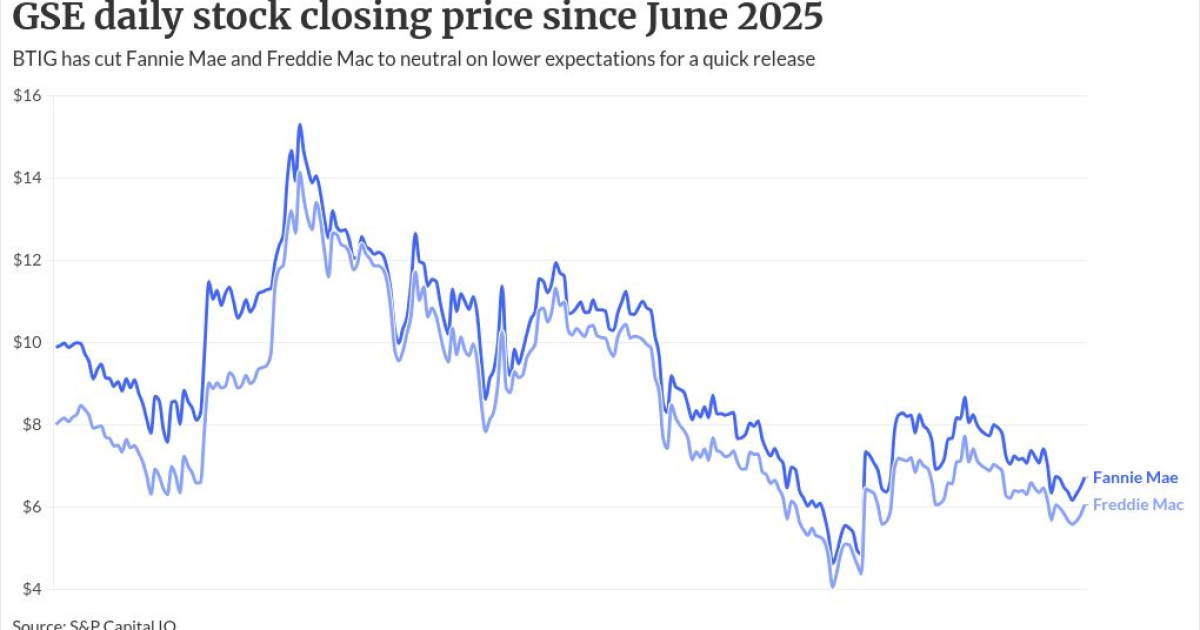
Where Fannie and Freddie stand
Fannie Mae's total assets slipped 0.7% in 2025 to $4.14 trillion, dragged down by a decline in mortgage-backed securities holdings, while Freddie Mac's assets rose 3.3% to $3.67 trillion, according to the FHFA report.
In contrast,
The report to Congress also confirmed that despite consistent profitability, Fannie and Freddie's capital levels remain below regulatory minimums and they appear likely to remain in conservatorship for the time being.
The capital levels are a key consideration in planning for the possibility of ending the conservatorships the GSEs have been in since 2008 due to a housing crisis at that time.
The Trump administration has contemplated engaging in a new offering for a small percentage of the GSEs' shares while capital levels are at current levels and the enterprises are in conservatorship as a way to monetize some of their value for the government.
President Trump has put a $1 trillion value on the GSEs that many analysts debate. He, Pulte and other administration officials have said an offering would only be staged if it was attractive enough.
An offering may be on hold until after the midterm elections and it could take seven to 10 years to rebuild sufficient capital under current standards, according to