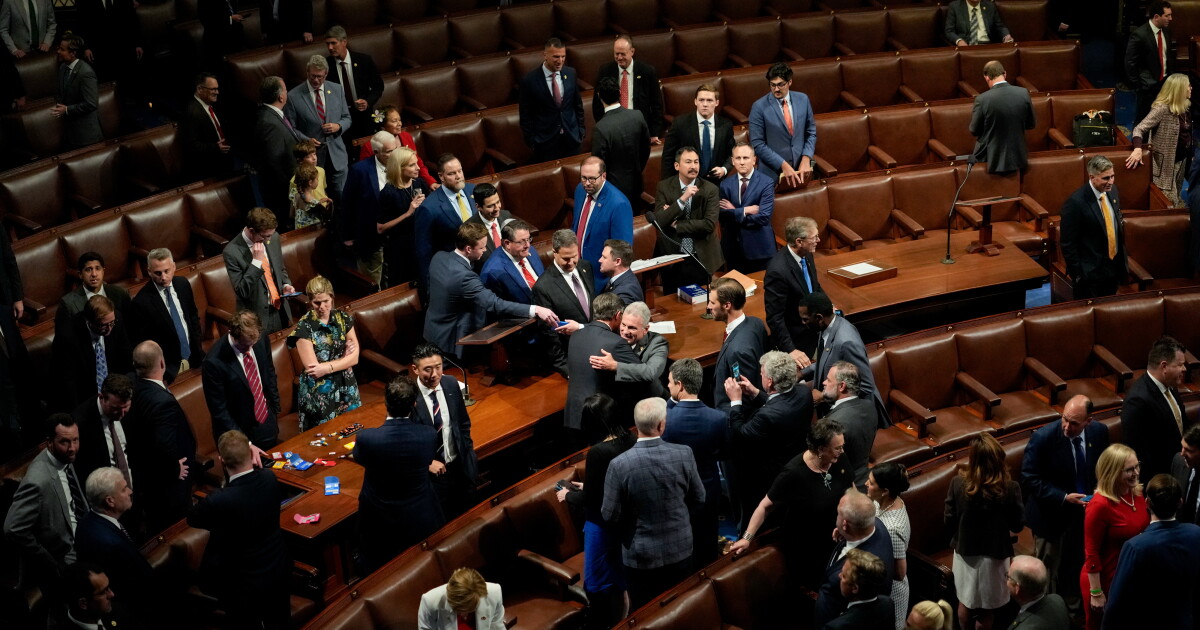
- Key insight: The Main Street Capital Access Act passed the House in a 270-155 vote.
- Forward look: It'd be very difficult to get new legislation through the Senate, especially with the opposition of Senate Banking Committee ranking member Sen. Elizabeth Warren, D-Mass., but the bipartisan appeal of the vote signals that some of the provisions may have a future.
- What's at stake: The package includes a long wishlist of items for banks large and small alike, including tailoring certain regulatory thresholds and indexing them to economic growth.
WASHINGTON — The House passed a
The package, the Main Street Capital Access Act, faces slim odds this Congress, as it'll have a hard time finding purchase with Senate Banking Committee ranking member Sen. Elizabeth Warren, D-Mass., and thus getting the Democrats required to get the necessary 60 votes in the Senate, especially with the limited legislative calendar ahead of midterms. Warren dismissed the bill in a statement as a corporate giveaway.
"The Main Street Capital Access Act is a massive giveaway to Wall Street masquerading as a community bank relief bill," Warren said. "The bill would relax supervision of big banks and their executives, fast track big bank mergers, exempt more big banks from enhanced oversight, and provide big bank lawyers with new tools to overturn safeguards and enforcement actions in court. And it shreds bipartisan compromises struck during the negotiation of the 21st Century ROAD to Housing Act, inviting much greater risk into the banking system."
But a number of Democrats voted to pass the bill, and a few provisions in the package have bipartisan support and could be future candidates for riders to must-pass legislation or a different broader package.
Rep. Bill Foster, D-Ill., led a 'dear colleague' letter to try and whip Democratic votes in favor of the package, challenging House Financial Services Committee ranking member Rep. Maxine Waters, D-Calif., who whipped against the bill.
Democrats Jim Himes of Connecticut, Vicente Gonzalez of Texas and Josh Gottheimer of New Jersey joined Foster in the letter ahead of the vote.
Read more:
The top-performing 20 public banks with under $2B of assets in 2025 'The data has to be perfect': BofA CEO Moynihan on AI A bank breaks its silence on its shadow-AI breach
Following the vote, Foster said that he worked with Republicans to change some of the provisions to make them safer, including on a bill that would index some regulatory thresholds to let well-managed and capitalized small banks to receive less-frequent examinations, while allowing regulators to intervene.
"Any claim that this bill is a handout to the biggest banks is disingenuous," Foster said in a statement after the vote. "In fact, it does the opposite by making it harder for the largest banks to grow even bigger by acquiring smaller, failing banks and ensuring that consumer protection fully remains part of regulators' review of existing rules. I am also deeply concerned that, as AI rapidly transforms our economy, we could be heading toward another crisis in our financial system."
The package is widely supported by the financial industry, including groups that represent both large and small institutions.
Some of the provisions aim to spur de novo bank formation, raise thresholds under which banks can qualify for less stringent oversight and create exceptions to the least-cost resolution framework for failed banks. Another measure in the package would require that bank regulatory thresholds tied to asset size be indexed to inflation and periodically adjusted. Yet another provision in the bill would make criteria for the management component of banks' CAMELS ratings reviewable.
The Bank Policy Institute, whose membership ranges from midsize and large banks, said that they support the bill because it allows more regulatory tailoring by size and risk profile, and indexes thresholds to economic growth. The group also supports the changes to the CAMELS rating system, and said that the package would update bank merger review standards.