- Key Insight: Richmond Fed President Tom Barkin believes that as businesses gain confidence in the country's robust economic demand and adjust to the new policy environment in Washington, hiring and investment should increase in the year ahead.
- Expert Quote: "Going forward, policy will require finely tuned judgments balancing progress on each side of our mandate." — Federal Reserve Bank of Richmond President Tom Barkin.
- What's at stake: After three consecutive interest rate cuts late last year, the Federal Reserve has signaled it will take a wait-and-see approach in 2026.
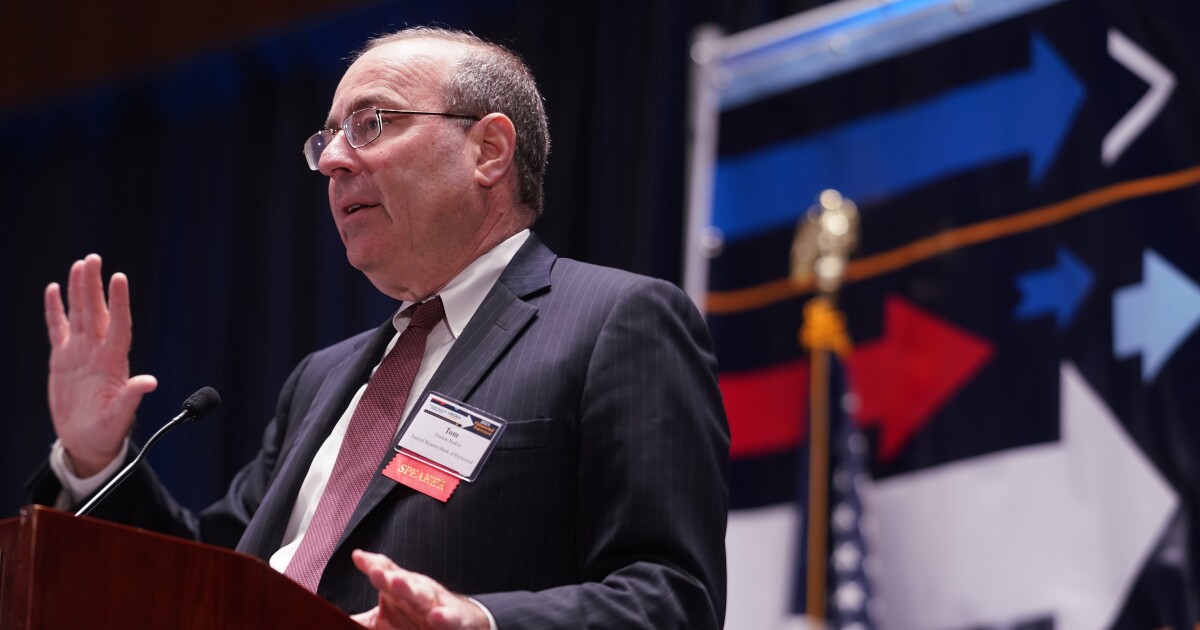
Federal Reserve Bank of Richmond President Tom Barkin struck a cautiously optimistic tone on the economy Tuesday, saying progress on inflation and labor markets could eventually allow policy to normalize, though risks remain on both sides of the Fed's mandate.
Speaking to the Raleigh Chamber of Commerce in Raleigh, N.C., Tuesday morning, Barkin said both employment and inflation "bear watching." Unemployment remains low by historical standards but has edged higher, while inflation is trending downward but remains above the Fed's 2% target, Barkin said.
"With the hiring rate low, no one wants the labor market to deteriorate much further; with inflation above target now for almost five years, no one wants higher inflation expectations to get embedded," Barkin said. "It's a delicate balance."
Barkin said uncertainty should ease this year as businesses gain confidence in demand and the policy environment, which he said should support hiring and investment.
He also said significant stimulus is likely to enter the economy in coming months.
"Fiscal stimulus from the recent tax bill is coming, most notably in tax refunds. Gasoline prices are down," Barkin said. "Deregulatory initiatives are rolling out. And the impact of the rate cuts we've made in the last 16 months — 175 basis points — should flow into the economy as well."
Barkin said the Fed's three interest rate cuts last fall were intended as "insurance" against a softening labor market. Looking ahead, he said monetary policy will require careful judgment as officials balance progress on inflation and employment.
His comments echoed those
The Fed's benchmark interest rate is currently
Barkin, who serves as an alternate voting member on the Federal Open Market Committee in 2026 and a voting member in 2027, said assessing economic conditions has been complicated by a lack of reliable data following a 43-day government shutdown in late 2025. He said clearer signals should emerge as more complete data become available in the coming weeks.
"We've been operating without data or with low-quality data that are hard to put much weight upon," Barkin said. "That makes our task a bit more challenging. So I'm looking forward to digging in and learning as clean data start to come in over the coming weeks."
Another regional Fed official, Minneapolis Federal Reserve President Neel Kashkari,
Speaking Monday, Kashkari, a voting member of the Federal Open Market Committee, said the Fed is likely near a neutral policy stance but must assess whether inflation or labor market conditions will ultimately drive future decisions.
"My guess is we're pretty close to neutral right now, and we just need to get more data to see which is the bigger force," Kashkari said. "Is it inflation, or is it the labor market? And then we can move from a neutral stance in whatever direction is necessary."
Fed watchers expect divisions within the FOMC to deepen in 2026 as both sides of the Fed's mandate remain under pressure.
Whether or not that actually presents issues in how the Fed-rate setting committee operates remains to be seen. For now, the disagreements among officials have been "thoughtful and respectful," Powell said following the December FOMC meeting.