

Fannie Mae reported a stronger profit in the first quarter as the company continues to get leaner.
The government-sponsored enterprise recorded $3.7 billion in net income during the period, a
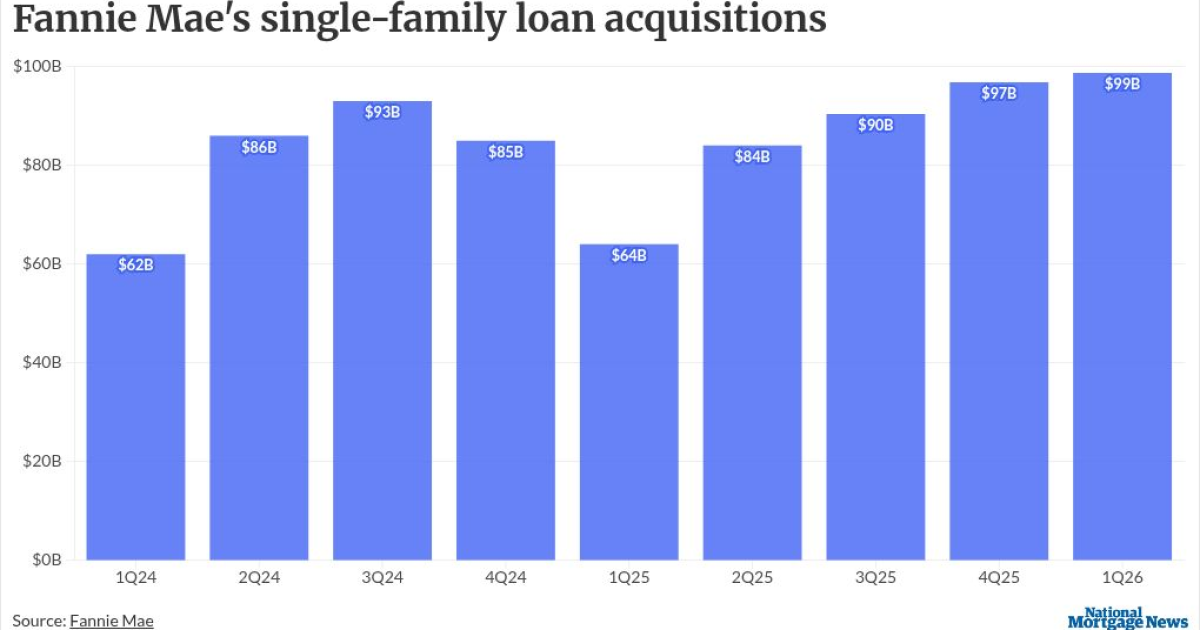
The company reported $98.7 billion in single-family loan acquisitions for the quarter, the highest mark since 2022, said Chief Financial Officer Chryssa Halley in an earnings call Wednesday. That included $43.8 billion in refinances. Halley said market volatility toward the end of the quarter didn't materially impact Fannie's earnings.
Net revenue and net interest income were steady quarter-over-quarter at $7.3 billion and $7.2 billion, respectively. The $5.9 billion in guarantee-fee revenue, 81% of the company's total net revenue, was "relatively stable" on a quarterly and annual basis, said Halley.
Company leaders, including Fannie Mae Chairman and Federal Housing Finance Agency Director Bill Pulte, lauded cost-cutting efforts that drove the GSE's administrative expense ratio down to 10.2% for the first quarter. Executives explained the 25% year-over-year reduction on a smaller workforce, less spending on contractors and consultants, and a reduced real estate footprint.
Fannie, still subject to a long-awaited conservatorship exit plan, also ended the first quarter with a net worth of $112.7 billion, up from $109 billion at the end of 2025. The company's net worth has grown by nearly $100 billion since January 2020, it said.
Inside the numbers
While Fannie reported $121 million in fair value gains for the quarter, its net revenue was mitigated by $277 million in credit loss provisions. The GSE said it built its single-family allowance by $14 million in the quarter, with a $103 million provision for the segment greater than the $89 million it reported in net charge-offs.
Series delinquencies in Fannie's single-family book were flat at 0.58% at the end of March, and slightly up 4 basis points for its smaller multifamily segment at 0.78%.
Other factors included investment losses on Fannie's purchases of mortgage-backed securities for its retained mortgage portfolio, in line with President Trump's directive
Total risk weighted assets rose slightly while risk density grew by around 1 percentage point from the fourth quarter to 32.8%. Halley said the shift was driven by Fannie's portfolio growth and less capital relief from credit risk transfer transactions.
The GSE also generated an increase on its illustrative return on required equity measure, rising 20 basis points on a quarterly basis to 10.4%. The measure is based on the quasi-public company's annualized year-to-date net income divided by its average common equity tier one capital requirements.
Wednesday's results come a week after Pulte announced that Fannie would
Shares of Fannie Mae, which opened at $7.73 Wednesday morning, quickly rose to $7.88 but tumbled down to $7.59 around noon. The stock has swung in the past year, rising over $15 per share last September but falling under $5 in March,